The Downwind Penalty: Measuring and Managing Wake Losses in American Wind Plants
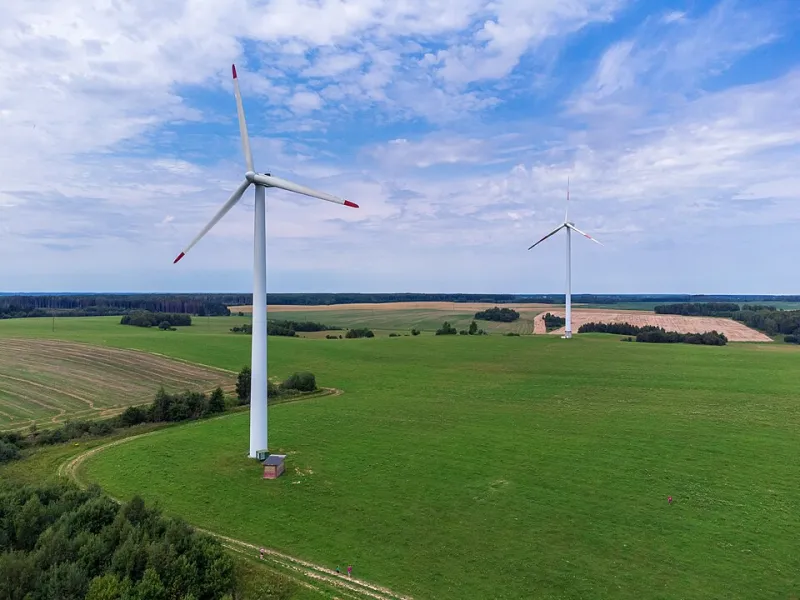
Photo: Budgawl, CC BY-SA 4.0, via Wikimedia Commons
Every wind plant creates its own internal weather. As wind passes through the first rows of turbines, the machines extract momentum and leave a slower, more turbulent flow downstream. That deficit is the wake, and it is one of the most persistent sources of lost generation in American wind farms. Wake effects do not appear as a fault code or a maintenance ticket. They show up as a gap between gross energy expectations and net production, and they can quietly reduce annual output by 10 to 20 percent depending on layout, spacing, wind direction, and atmospheric conditions.
The Downwind Tax
A wind farm's gross energy estimate assumes that each turbine sees an undisturbed wind resource. The net estimate accounts for array losses, electrical losses, availability, and curtailment. Wake loss is the portion of the gap caused by upstream machines reducing the wind speed and increasing turbulence at downstream rotors. In large US projects, especially those with tight spacing or highly directional wind regimes, wake loss can be the largest single category of non-resource energy loss.
The penalty is not uniform. It varies by wind direction, turbine row, atmospheric stability, and turbine operating state. Under stable nighttime conditions, wakes can extend farther and remain more coherent. Under turbulent daytime conditions, they mix out faster but can still impose load and performance penalties. A plant that performs well on an annual average may still suffer severe wake losses in specific wind sectors, and those sector-level losses are often masked by aggregate reporting.
How Wake Losses Are Measured
Wake loss measurement begins with a credible free-stream reference. Operators use meteorological masts, nacelle anemometry, scanning LiDAR, and nearby reference turbines to estimate what an undisturbed wind speed should have been. The reference is then compared with actual turbine performance, typically through a power-ratio method or a calibrated wake model. The difference, after correcting for availability, curtailment, and electrical losses, is attributed to wakes.
The quality of that attribution depends on data discipline. Turbine state codes must be reconciled with energy production. Derated turbines must be excluded or modeled explicitly. Wind direction must be filtered and binned, not averaged into a single sector. Energy-weighted loss factors are more meaningful than simple time-weighted averages because the hours that matter most are the hours with the most generation. For US asset owners, the practical test is whether the wake loss estimate can be reproduced from SCADA data by an independent engineer without access to the original assumptions.
What US Field Evidence Suggests About Steering
Yaw-based wake steering is conceptually simple. Instead of pointing every rotor directly into the wind, an upstream turbine is intentionally misaligned by a small angle so that its wake is deflected away from a downstream machine. The upstream turbine sacrifices a small amount of power; the downstream turbine recovers more. The net effect can be positive when the array layout, wind direction, and controller are favorable.
Field campaigns and commercial trials in the United States have produced measured gains that are real but conditional. Reported annual energy improvements have generally been modest, often in the low single digits at the plant level, with larger gains in specific wind sectors and smaller or negative results elsewhere. The variance is not a failure of the concept. It reflects differences in spacing, turbine model, atmospheric stability, controller tuning, and measurement uncertainty. A steering strategy that works well in a tightly spaced array in the Great Plains may deliver little benefit in a widely spaced coastal project.
Steering also changes loads. Misaligned rotors can increase yaw-system duty, blade-root fatigue, and tower loads. Those effects must be evaluated against turbine warranties and component life. A wake-steering business case that counts energy upside but ignores actuator wear and maintenance cost is incomplete.
Metrics to Track Before Betting on Controls
Before approving a wake-steering upgrade, operators should establish a baseline that is more granular than annual AEP. The minimum set includes energy-weighted wake loss by wind direction sector, array efficiency by row, production-based availability, yaw misalignment distribution, controller uptime, and the frequency of curtailment or grid constraints. Each metric should be paired with an uncertainty estimate.
The upgrade case should then be framed as a measured uplift range, not a single headline number. A reasonable package includes P50 and P90 AEP uplift, the expected change in O&M cost, the effect on turbine loads, and the cost of validation. A control-system vendor's modeled gain is a starting point, not a result. Independent measurement and verification, ideally using a holdout period or a control group of turbines, is the only reliable way to separate steering gains from weather variation.
A Practical Conclusion
Wake losses are not exotic. They are a structural feature of array operation, and they deserve the same accounting rigor as availability or curtailment. The most valuable first step is not a new controller. It is a defensible wake loss baseline that separates resource variation from array effects. Once that baseline exists, yaw-based steering can be evaluated as one option among several, including layout optimization, operational set-point changes, and repowering. The megawatt-hours are real, but they are hiding in the measurement details.