Aging Blades, Shrinking Output: What Field Data Reveals About Long-Term Wind Turbine Performance Decline
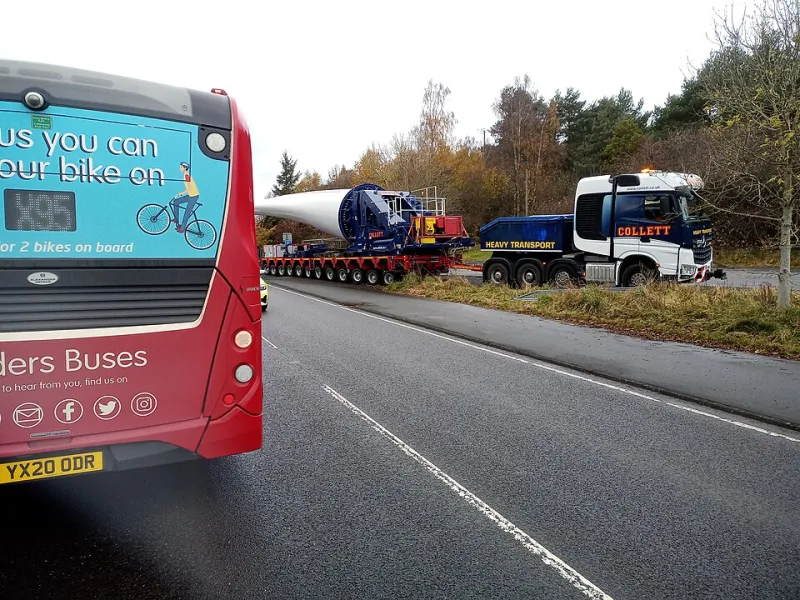
Photo: Victuallers, CC BY-SA 4.0, via Wikimedia Commons
When a wind turbine leaves the factory, its blades represent some of the most precisely engineered aerodynamic structures in commercial use. Their profiles are optimized to extract the maximum possible kinetic energy from moving air across a service life that manufacturers typically project at 20 to 25 years. Yet operators across the United States are increasingly confronting a troubling pattern: actual blade performance degrades at rates that engineering models, even sophisticated ones, frequently underestimate. The gap between projected and measured output is not trivial. In some cases, it accumulates into percentage points of annual energy production loss that, across a fleet of turbines, translate directly into millions of dollars in unrealized revenue.
Understanding why this happens — and what can be done about it — has become one of the more pressing technical challenges in the US wind energy sector.
The Aerodynamic Precision That Erosion Destroys
A turbine blade functions on the same fundamental principles as an aircraft wing. The leading edge, which strikes oncoming air first, is the most aerodynamically critical surface on the structure. Its curvature and smoothness determine how cleanly airflow separates and accelerates over the blade's upper surface, generating the lift that drives rotation. Even minor surface irregularities at the leading edge disrupt this flow, increasing drag and reducing the lift coefficient that determines how efficiently kinetic wind energy converts to rotational mechanical energy.
In field conditions, that leading edge faces punishment that wind tunnel testing cannot fully replicate. Rain droplets striking blade tips — which on modern utility-scale turbines can travel at speeds exceeding 180 miles per hour — exert repeated impact forces that gradually erode the protective coating and, eventually, the composite substrate beneath it. Airborne particulates, insects, and in northern US states, ice accretion, contribute additional surface roughness. Studies examining blades removed from operating turbines in the Great Plains and Midwest have documented pitting, delamination, and erosion cavities that progress from cosmetic surface damage to structural compromise over operational timescales measured in years rather than decades.
The aerodynamic consequence of this progression is measurable. Research drawing on SCADA data from operating US wind farms has found that leading edge erosion alone can reduce annual energy production by between 2 and 5 percent on affected turbines, with losses on the most severely degraded blades reaching as high as 9 percent under certain wind speed conditions. These figures stand in contrast to the sub-1 percent annual degradation rates that many earlier manufacturer performance warranties implied.
Soiling and Its Compounding Effect
Separate from mechanical erosion, surface soiling presents a distinct and often underappreciated drag on blade efficiency. Biological matter — insect remains in particular — accumulates on leading edges during warmer months and alters the blade's effective surface geometry. This so-called "bug contamination" effect has been documented extensively in European studies and is increasingly recognized as a meaningful performance factor at wind farms across the US interior, where warm summers and high insect populations create ideal accumulation conditions.
What makes soiling particularly problematic from a performance analysis standpoint is its interaction with wind speed. At lower wind speeds, soiled blades can experience disproportionately large lift reductions because the boundary layer separation that soiling induces is more disruptive when airflow velocities are already marginal. This means that wind farms in regions characterized by moderate, variable wind resources — much of the central and eastern United States — may be more vulnerable to soiling-driven losses than sites with consistently strong winds where blade aerodynamics are less sensitive to surface condition.
Soiling losses are also asymmetric across a rotor. The outer third of the blade, where rotational velocity and aerodynamic loading are greatest, accumulates contamination faster and suffers proportionally larger efficiency penalties. Performance modeling that treats the blade as a uniform surface therefore systematically underestimates the magnitude of soiling-driven output reduction.
Material Fatigue and Structural Deflection
Beyond surface degradation, the composite materials from which modern blades are constructed undergo cumulative fatigue damage through the mechanical loading cycles that accompany every rotation. Each pass through the rotor plane subjects the blade to bending moments and torsional stresses that, over millions of cycles across a 20-year service period, can alter the blade's structural stiffness and, consequently, its aeroelastic behavior.
As blade stiffness changes, so does the degree to which the blade deflects under aerodynamic loading. Increased deflection modifies the effective angle of attack along the blade's span in ways that can subtly but persistently shift the blade away from its optimal operating configuration. This structural drift is not captured in static performance models, and it contributes to a form of efficiency loss that is particularly difficult to detect without detailed structural monitoring because it manifests gradually and lacks the visible signature of surface erosion.
Some US operators have begun deploying fiber optic strain sensing systems embedded within blade structures to track deflection behavior over time, providing the kind of longitudinal data that could eventually allow more accurate predictive models of fatigue-driven performance decline.
The Measurement Gap: Why Models Fall Short
The persistence of the gap between modeled and measured degradation rates reflects several interconnected limitations in how blade performance is typically assessed. Manufacturer specifications are derived from accelerated aging tests and computational fluid dynamics simulations that, by necessity, make simplifying assumptions about operating environments. Real US wind farm sites expose blades to combinations of thermal cycling, humidity variation, ultraviolet radiation, and mechanical loading that no laboratory protocol fully replicates.
Furthermore, the performance monitoring infrastructure at many operating wind farms was not designed with fine-grained blade degradation tracking in mind. Standard SCADA systems capture power output, rotational speed, and wind speed at the nacelle, but they do not directly measure blade surface condition or aerodynamic efficiency. Attributing observed output decline to blade degradation specifically — rather than to drivetrain wear, control system drift, or site-level wind resource variation — requires analytical methods that many operators have only recently begun to adopt systematically.
Mitigation Technologies Gaining Ground
The industry's response to documented degradation rates has accelerated in recent years. Leading edge protection systems, applied either during manufacture or as field-installed retrofits, have demonstrated meaningful erosion reduction in both controlled testing and operational deployments. These systems typically consist of polyurethane tapes or thermoplastic elastomer shells bonded to the leading edge surface, providing a sacrificial wear layer that can be replaced without blade removal.
Robotic inspection and automated cleaning platforms are also moving from experimental deployment toward broader commercial availability. Several US operators have piloted drone-based inspection programs capable of generating high-resolution surface condition maps across entire turbine fleets, enabling targeted maintenance intervention before degradation reaches the threshold where aerodynamic losses become significant. Paired with machine learning tools that correlate surface condition imagery with SCADA performance data, these systems offer the prospect of condition-based blade maintenance strategies that are considerably more precise than the calendar-based inspection schedules that have historically prevailed.
Leading edge erosion coatings incorporating self-healing polymer chemistry represent a longer-horizon technology that has shown early promise in laboratory settings, though commercial-scale field validation at US wind farms remains limited.
Preserving Output Across the Service Window
The 20 to 30-year operational lifespan of a utility-scale wind turbine represents an enormous accumulated energy production commitment. Degradation rates that appear modest in any single year compound over that timeframe into substantial cumulative output losses — losses that directly affect the financial performance of wind farm assets and the effective cost of the energy they deliver to the grid.
For the US wind industry, which is simultaneously managing an aging installed base and expanding into new markets where long-term performance credibility matters, closing the gap between modeled and actual blade degradation trajectories is not an academic exercise. It is a core operational and economic priority. The data that operating wind farms are now generating, combined with improving analytical tools, provides the foundation for more accurate degradation models and more effective mitigation strategies. Whether operators move quickly enough to capture that value remains the central question.