Listening for Failure: How Acoustic Monitoring Is Quietly Transforming Gearbox Maintenance Across US Wind Farms
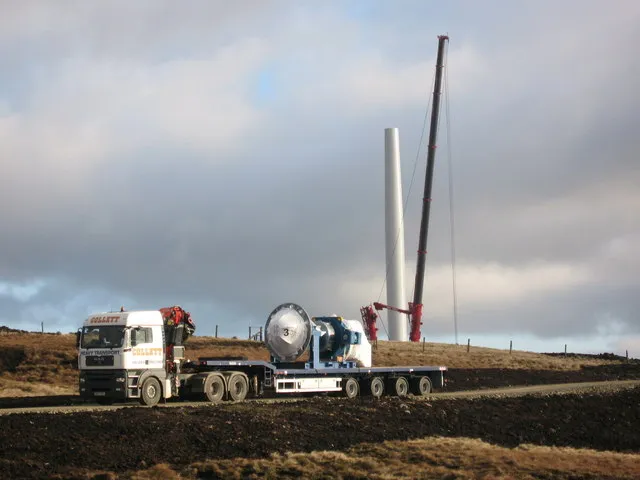
Photo: Paul Anderson, CC BY-SA 2.0, via Wikimedia Commons
A gearbox failure on a utility-scale wind turbine is not merely an inconvenience. Replacement costs routinely exceed $300,000 per unit when parts, crane mobilization, and lost generation revenue are factored together. For a wind farm operator managing a fleet of 100 turbines across the Great Plains or the Pacific Northwest, even two or three unplanned gearbox replacements in a single season can materially erode annual revenue projections. The question that has occupied maintenance engineers for the better part of two decades is straightforward: can failure be anticipated rather than discovered?
The answer, increasingly, is yes — and the mechanism is sound.
The Physics of Mechanical Degradation
Gearboxes in modern horizontal-axis wind turbines operate under conditions that few other industrial drivetrain components must endure. They are subjected to fluctuating torque loads driven by variable wind speeds, thermal cycling as ambient temperatures shift from pre-dawn lows to afternoon highs, and the persistent micro-vibrations generated by rotor imbalance and blade passage events. Each of these stressors contributes to incremental wear on gear teeth, bearing races, and planetary carrier assemblies.
As wear progresses, the mechanical signatures it produces change in measurable ways. Healthy gear mesh generates a characteristic frequency spectrum determined by the number of teeth in contact and the rotational speed of each shaft stage. When a tooth begins to pit, spall, or crack, that spectrum changes. Sidebands appear around the fundamental mesh frequency. Amplitude modulation increases at harmonics tied to the rotational frequency of the damaged component. To a trained analyst — or, increasingly, to a well-configured machine learning algorithm — these spectral shifts are readable text.
Acoustic emission monitoring extends this principle into a higher-frequency domain. Where conventional vibration sensors typically operate in the range of 0 to 20 kilohertz, acoustic emission transducers capture stress-wave events in the range of 100 kilohertz to 1 megahertz. At these frequencies, the transient energy released by a propagating micro-crack or a sub-surface inclusion beginning to shear is detectable well before it manifests as a visible defect or a change in the low-frequency vibration signature. This earlier detection window is precisely what makes the technology commercially significant.
From Signal to Decision: How US Operators Are Using the Data
Several of the larger independent power producers operating in Texas, Iowa, and the Midwest have integrated continuous vibration and acoustic monitoring into their operational frameworks over the past five years. The architecture typically involves accelerometers mounted on the gearbox housing at each stage, acoustic emission sensors positioned near the high-speed shaft bearings, and a data acquisition system capable of streaming processed spectral data to a cloud-based analytics platform.
One operator managing approximately 400 turbines across two Texas wind projects reported that after deploying a continuous monitoring system, the average lead time between first anomaly detection and confirmed gearbox fault extended to between six and fourteen weeks. That window is operationally transformative. Rather than mobilizing a crane on an emergency basis — which in rural West Texas can add significant logistical cost and scheduling delay — the maintenance team can plan the intervention during a low-wind period, pre-order the replacement gearbox, and coordinate crane availability weeks in advance.
The same operator estimated that planned gearbox replacements cost approximately 40 percent less than emergency replacements when all associated costs were included. Across a fleet of that size, even a modest reduction in unplanned failure frequency produces annual savings measurable in the low millions of dollars.
The Role of Machine Learning in Pattern Recognition
Raw spectral data from a continuously monitored gearbox is voluminous. A single turbine may generate several gigabytes of vibration data per day, and manually reviewing that volume across a large fleet is not operationally feasible. This is where machine learning architectures — particularly those trained on labeled datasets of healthy and degraded gearbox signatures — add substantial value.
Algorithms trained on historical failure data can identify the characteristic spectral fingerprints of specific fault modes: planetary bearing defects, ring gear tooth fatigue, high-speed shaft bearing spalling, and oil film breakdown at gear mesh interfaces. When a monitored turbine's signature begins trending toward a known fault pattern, the system generates an alert ranked by estimated severity and projected time to failure.
The quality of these predictions depends heavily on the size and diversity of the training dataset. Vendors who have accumulated labeled failure data from thousands of turbines across multiple gearbox manufacturers and climate zones produce meaningfully more accurate models than those working from smaller samples. For US operators evaluating monitoring platforms, the depth of the underlying dataset is arguably the most important due diligence criterion.
Quantifying the Return on Investment
The capital cost of deploying a full acoustic and vibration monitoring system on a single turbine typically falls in the range of $5,000 to $15,000, depending on sensor count, data acquisition hardware, and the terms of the analytics platform subscription. Across a 100-turbine fleet, total deployment costs might range from $500,000 to $1.5 million.
Against that investment, operators must weigh the expected reduction in catastrophic failure costs. Industry data suggests that roughly 3 to 5 percent of utility-scale turbine gearboxes will experience a significant fault in any given year. On a 100-turbine fleet, that implies three to five potential failure events annually. If continuous monitoring converts even two of those events from unplanned emergency replacements to planned interventions, the cost avoidance — at a conservative $120,000 per event — approaches $240,000 in year one alone. The system typically reaches payback within two to four years, with ongoing savings accumulating through the remaining operational life of the fleet.
Those figures do not account for generation revenue preserved by reducing unplanned downtime, which for a turbine with a capacity factor of 35 percent and a power purchase agreement price of $25 per megawatt-hour can add several thousand dollars per day of avoided outage.
The Limits of Current Technology
Acoustic monitoring is not without constraints. Sensor placement is critical; a transducer mounted even a few centimeters from the optimal location on a gearbox housing can produce attenuated or distorted signals that reduce detection reliability. Background noise from rotor aerodynamics, tower structural resonances, and electrical components can contaminate the acoustic emission signal if filtering is not properly configured. And the technology remains more effective at detecting bearing and gear tooth faults than at identifying certain lubrication-related degradation modes, which may require complementary oil debris monitoring to address comprehensively.
Nevertheless, the trajectory of adoption among US wind operators is clear. As fleet ages increase and the proportion of turbines operating beyond their original design life grows, the financial pressure to extend gearbox service intervals through predictive intervention rather than scheduled replacement will only intensify.
A Measurable Competitive Advantage
For wind farm operators competing in merchant power markets or seeking to optimize returns under fixed-price contracts, the ability to reduce unplanned downtime and control major component replacement costs is not a peripheral concern — it is a core performance variable. Acoustic emission monitoring and vibration signature analysis represent one of the more technically mature tools available to achieve that outcome.
The turbines themselves cannot speak. But they are, it turns out, constantly broadcasting the state of their internal health to anyone equipped to listen.